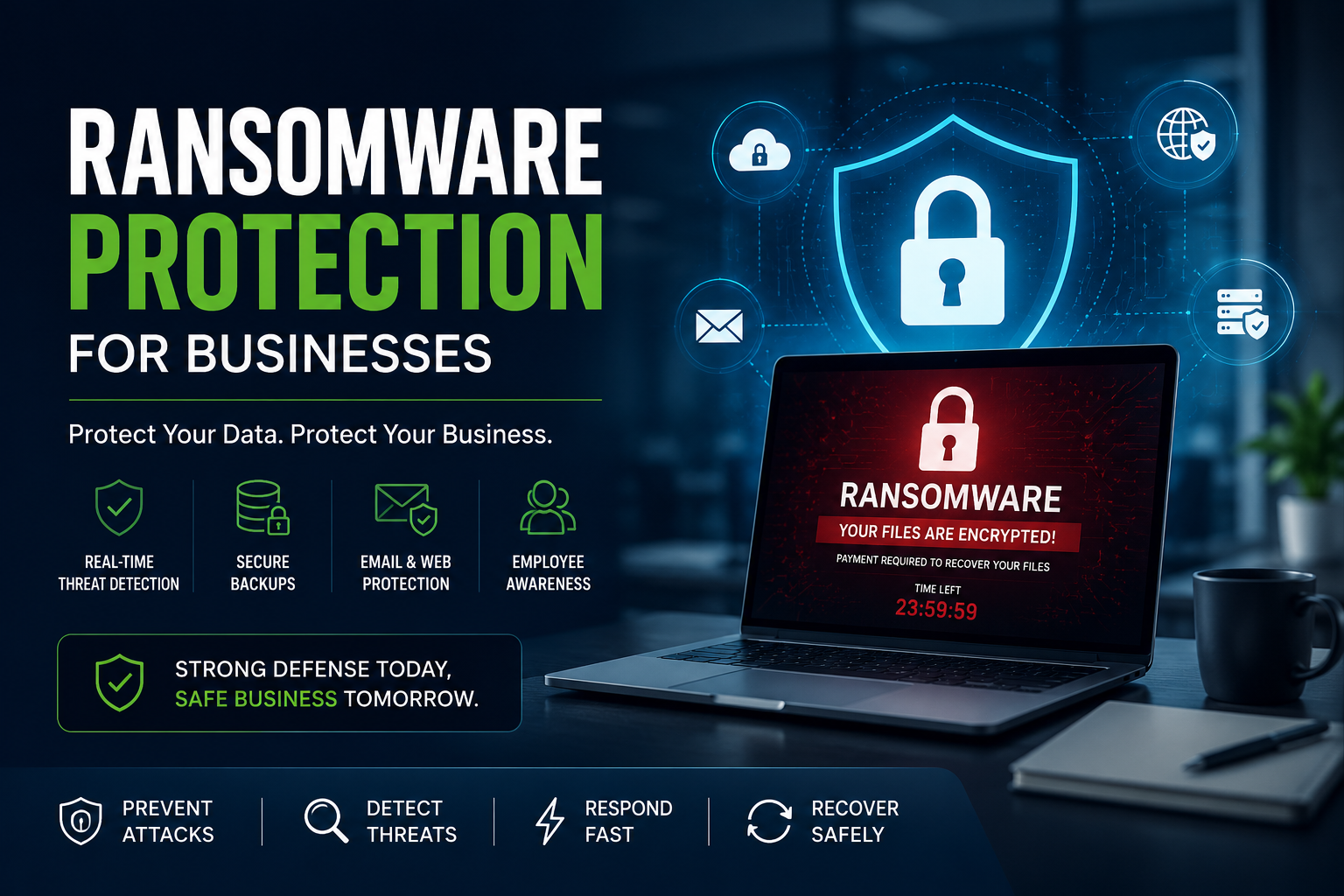
Why ransomware protection for businesses needs to be a priority now.
Ransomware protection for businesses is no longer just an IT issue; it’s a matter of business continuity. The attack doesn’t just target those who “seem vulnerable”; it exploits exposed credentials, known vulnerabilities, unprotected services, and environments that haven’t been updated in time. Official guidelines from CISA and Microsoft reinforce this: keep software and operating systems updated, prioritize patches on servers exposed to the internet, and prepare the organization to quickly detect, contain, and recover from an incident. CISA itself describes ransomware as an event that requires prevention, response, and recovery working together, not as an isolated antivirus action
For IT managers, the central point is simple: ransomware is not just file encryption. It’s operational disruption, loss of access, pressure on leadership, and, in many cases, a real risk of data loss and prolonged downtime. CISA itself describes ransomware as an event that requires prevention, response, and recovery working together, not as an isolated antivirus action.
How modern attacks exploit credentials, vulnerabilities, and outdated systems.
Modern attacks typically don’t start with a “big fuss.” They begin with something far more mundane: a reused password, a service without MFA, a forgotten application, a server that fell outside the patching window, or a backup accessible over the same network as the rest of the environment. CISA explicitly recommends that organizations maintain offline and encrypted backups, regularly test their integrity, and apply patches quickly, especially to assets exposed to the internet.
Microsoft, in its ransomware defense documentation, also highlights that attackers often seek credentials to gain administrative control before deploying malware. In other words, the problem is often not just a “technical flaw,” but a combination of poorly protected privileged access and insufficient security hygiene. (See also: Information Security: Main Risks and How to Protect Yourself )
This explains why ransomware protection for businesses needs to be thought of as an ongoing process, not a one-off project. If a company fixes a vulnerability today but delays patches again tomorrow, the window of risk remains open.
The real impact on operations, cash flow, reputation, and business continuity.
When an attack occurs, the damage is not limited to the IT department. Operations come to a standstill, entire teams become dependent on manual processes, clients experience downtime, and management is forced to make decisions under pressure. CISA advises companies to prioritize isolating affected systems and coordinated reporting with internal and external areas, precisely because the impact spreads rapidly.
There are also invisible costs: rework, delivery delays, overtime, legal risk, and brand damage. When a company cannot restore data and services quickly, the financial damage cascades. That’s why backup, patching, and incident response are not “technical layers”; they are instruments for protecting cash flow and reputation.
And here’s a point that many managers underestimate: having a plan isn’t enough. The plan needs to work under pressure. Microsoft recommends response drills, and CISA reinforces the need for regular backup tests and ransomware drills to assess whether recovery actually happens.
For entrepreneurs and managers interested in how operational risks impact online businesses, resources focused on digital entrepreneurship can help contextualize business continuity, for example, 10 Criteria for Choosing an IT Company Success Story Starts Here .
Backup and recovery as the foundation of ransomware protection for businesses.
If there’s one game-changing pillar, it’s backup. Not just any backup. A backup designed for true restoration, with protected, tested copies independent of the environment that could be compromised. CISA recommends maintaining offline, encrypted, and regularly verified backups because many ransomware programs specifically target accessible backups to destroy or encrypt them before demanding payment.
In corporate environments, the best strategy often combines three elements: offline backup for attack resistance, cloud backup for operational resilience, and immutable copies to prevent unauthorized changes. The goal is not just to store data; it’s to ensure that it remains restorable when the worst happens.
Offline, cloud, and immutable backup strategies.
Offline backup remains an essential defense because it breaks the direct link between protected data and the at-risk environment. If ransomware spreads across the network, it finds it much more difficult to reach a truly isolated copy. CISA is clear in recommending offline or cloud-to-cloud backups, always with integrity validation.
Cloud backup offers speed and flexibility, especially in distributed environments. It helps reduce downtime and simplifies recovery for teams operating outside the main office. But the cloud alone doesn’t solve everything. If the administrative account is compromised, the attacker can try to delete snapshots, change policies, or block access. That’s why immutable copies and credential segregation make a difference.
A practical model for IT managers is to think like this:
This arrangement does not eliminate the incident, but it dramatically reduces the chance of the company being left with no way out.
Restoration, retention, and integrity validation tests
Untested backups are hope, not strategy. CISA documentation advises organizations to regularly test backup procedures and verify the integrity of copies in a disaster scenario. Microsoft follows the same line, recommending backup and restore plans designed to protect critical systems before and during an attack.
In practice, testing needs to go beyond “the job finished successfully.” It’s necessary to answer uncomfortable questions: were we able to restore within the timeframe accepted by the business? Is the data consistent? Does the database open? Does the application start? Does the directory authenticate again? Without this, the backup may technically exist and, at the same time, be unusable in a crisis.
Data retention is also important. Some companies maintain few restore points and end up without a clean version of their data when they discover that the infection has been present for days. Retention needs to cover a sufficient window to identify the moment of contamination and revert to a secure copy.
Patching and vulnerability management to reduce the attack surface.
If backup is the safety net, patching is daily prevention. And, in the case of ransomware, it’s a prevention that cannot be treated as a low-priority task. CISA advises organizations to keep software and operating systems up-to-date and prioritize patches on servers exposed to the internet, including browsers, plugins, and document readers.
Effective vulnerability management isn’t just about “staying up-to-date.” It’s about reducing real opportunities for intrusion. This involves viewing the environment hierarchically: what is exposed, what holds privileges, what supports critical services, and what can be exploited in a chain reaction.
Priorities for servers, endpoints, applications, and exposed assets.
Not all fixes are equally urgent. Servers published on the internet, VPNs, firewalls, remote access solutions, and systems that centralize authentication need to be prioritized. Then come workstations, corporate applications, and supporting components. The logic is straightforward: attackers tend to target the most visible and valuable points of attack.
Microsoft also points out that ransomware actors typically seek administrative control and high-availability targets before launching the malicious payload. This means that critical assets and privileged identities require special attention.
In mature environments, risk classification makes the conversation more objective. A failure in an internal system without direct exposure can wait longer than a critical vulnerability in an edge service. This prioritization avoids wasted effort and focuses energy where the risk is greatest.
How to organize update windows without compromising availability.
Many companies postpone patching because they fear halting operations. The result is well-known: the risk increases precisely to avoid a short interruption. The solution is not to ignore the update; it’s to create well-planned windows, with prior communication, a defined rollback, and post-patch validation.
An effective routine typically includes three steps: asset inventory, criticality analysis, and a recurring application schedule. Instead of deciding on updates on a case-by-case basis at the last minute, the team starts working with predictability. This reduces surprises and improves buy-in from business areas.
It also makes sense to separate emergency patching from scheduled maintenance. If an actively exploited vulnerability emerges, the priority immediately increases. CISA recommends paying attention to known exploited vulnerabilities, that is, flaws already known to be in use.
Incident response for IT managers: contain, communicate, and recover quickly.
When the alert is triggered, time becomes a strategic asset. Incident response needs to be quick, coordinated, and disciplined. CISA recommends first identifying the affected systems and isolating them immediately, prioritizing critical assets and, if necessary, taking the network offline at the switch level to contain the spread.
The company that responds best isn’t the one that’s never attacked. It’s the one that knows what to do without improvising. And that requires a clear roadmap, defined contacts, and well-defined roles before the crisis.
Initial isolation, preservation of evidence, and activation of the plan.
The first decision is to contain the spread. Then, preserve evidence. CISA recommends capturing system and memory images when initial mitigation is not possible, as well as collecting relevant logs and malware samples or indicators of compromise. This helps both in the investigation and in the possibility of finding decryption tools with the support of authorities or researchers.
Microsoft also highlights the importance of containment and post-incident procedures, focusing on secure backups and a structured response. In practical terms, this means that the team should not rush to “clean everything up” before documenting what happened. If the evidence disappears, the analysis is weaker and recovery can be more expensive.
A good rule of thumb is this: contain first, document in parallel, and recover methodically. Improvising here is costly.
Relationship between internal team, suppliers and senior leadership during the crisis.
In a ransomware incident, IT cannot solve the problem alone. CISA recommends involving management, internal teams, MSSPs, cyber insurers, and, when applicable, authorities such as the FBI and CISA, keeping leadership informed through regular updates.
This is important because the crisis has three dimensions simultaneously. There’s the technical dimension, with restoration and containment. There’s the executive dimension, with priorities, risk, and decision-making. And there’s the communication dimension, with internal and external messages. When these fronts become disconnected, recovery slows down.
IT managers therefore need to speak the language of the business: downtime, impact on revenue, regulatory risk, and estimated time to return to operation. Leadership doesn’t just want to know “what happened”; they want to know “when we’ll be back” and “what’s needed for that.”
How the Azaz Proactive Platform strengthens the company’s ongoing defense.
Defense against ransomware benefits greatly from continuous prevention, monitoring, and recovery operations. This is precisely where the Azaz Proactive Platform fits in: a model that combines managed antivirus, backup, recovery, and patch management to mitigate vulnerabilities before they become incidents. Based on its stated positioning, the solution was designed for high availability, proactive prevention, and genuine support for the internal team, helping to free up time for more strategic initiatives.
The value of this approach lies in its consistency. Instead of relying on the manual discipline of each area, the company has an operational layer that monitors, corrects, and protects on an ongoing basis. This is especially useful for organizations that need security without increasing internal complexity.
Managed antivirus, backup, patches, and reports in a preventative operation.
The integration between managed antivirus, backup, and patching makes sense because modern attacks rarely exploit a single point. Often there is a sequence: initial entry, privilege escalation, lateral movement, and finally, encryption. A preventative operation needs to attack this chain at different stages.
When the environment receives continuous management, the company gains visibility into what is protected, what is outdated, and what can be restored. This reduces the scope for surprises. And it also reduces the risk of leaving a critical asset forgotten for months.
Reports are equally valuable. For managers, it’s not enough to “be safe”; they need to see evidence that the protection is active. This type of transparency improves governance and supports fact-based decisions.
Availability, operational reliability, and reduced internal team effort.
The most concrete promise of a platform like this is not just increased security. It’s greater availability. CISA documentation reinforces that well-structured backup and response systems reduce downtime and increase the chance of recovery. The very idea of operating with continuous prevention directly addresses this goal.
There is also an important human benefit: less burden on the internal team. When repetitive patching, monitoring, and verification tasks are handled by a specialized operation, the IT team can focus on what truly needs strategic attention. In companies with lean teams, this makes an immediate difference.
And there’s a peace of mind component that shouldn’t be ignored. Knowing that the infrastructure is being monitored, that backups are protected, and that there’s a tested recovery process changes the leadership’s attitude. The environment ceases to depend on luck.
Next steps to move forward more safely.
If your company still treats ransomware as an abstract risk, now is the time to correct that. Start by doing the basics well: review backups, test restores, prioritize patching critical assets, and formalize an incident response that truly works under pressure. CISA and Microsoft unanimously point to these fundamentals as essential for prevention and recovery.
In practice, the next step is to move from theory to action. If you need support to structure this defense with more predictability, the Azaz Proactive Platform can help create a continuous layer of protection, backup, and patch management, focusing on availability and risk reduction.
