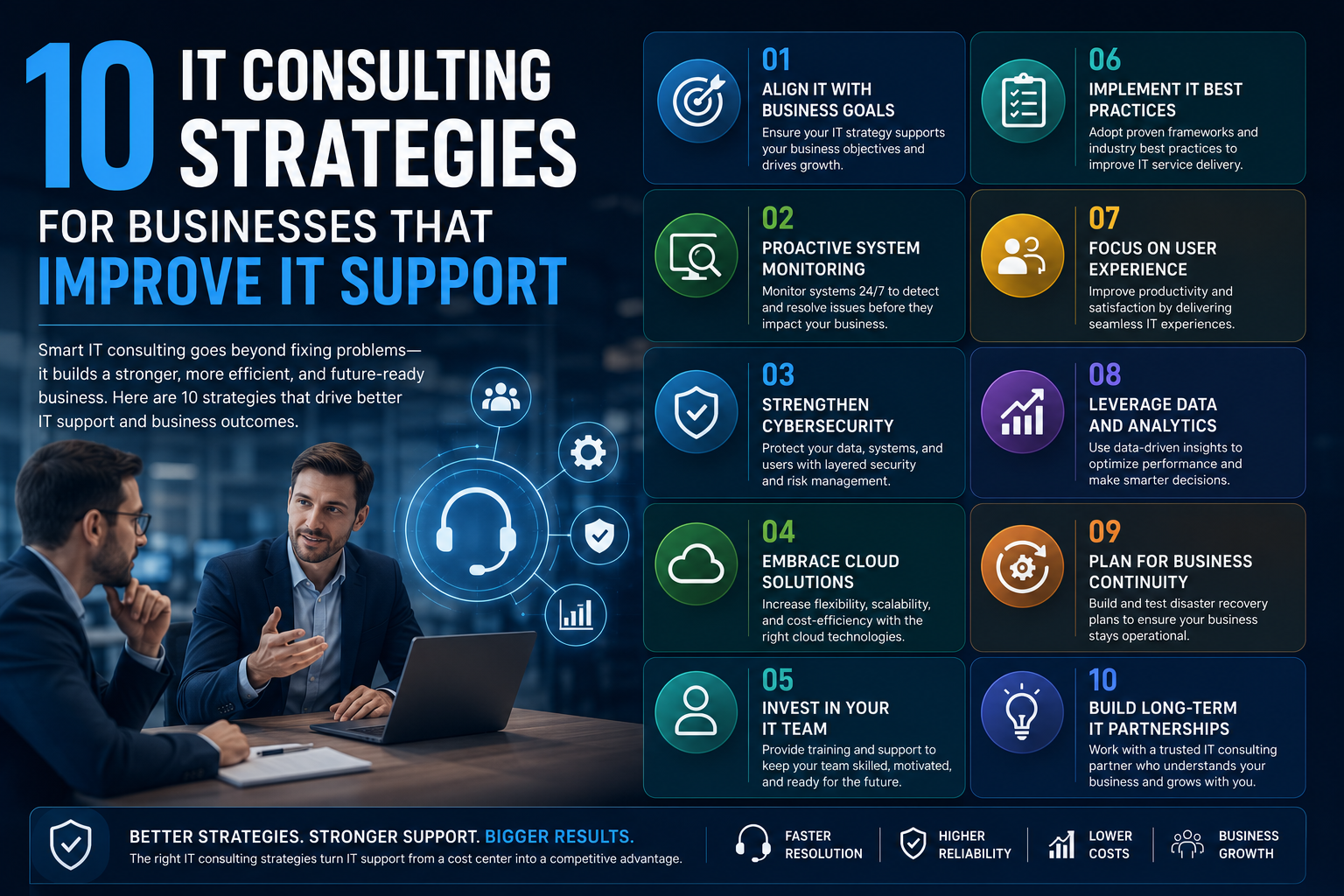
How IT consulting for businesses is shifting IT support from reactive to proactive.
When IT operations are constantly “putting out fires,” everything else slows down. Urgent calls, rework, recurring failures, missed maintenance windows, exhausted teams. For technology managers and coordinators, this scenario is not only draining—it consumes budget, reduces predictability, and undermines the perceived value of IT within the company.
This is where IT consulting for businesses truly makes a difference. Instead of acting only after a problem arises, consulting firms organize processes, anticipate risks, and structure more stable and measurable IT support for companies. This approach combines monitoring, preventative routines, documentation, and incident management to reduce downtime and improve business continuity. The logic is clear: less surprise, less downtime, less hidden cost.
Why does the overburdened operation need to get out of firefighting mode?
Operational overload often stems from repetitive tasks, a lack of standardization, and dependence on specific individuals. An alert that no one saw, a backup that was never tested, a patch that was postponed. And when the team is already under pressure, any small deviation becomes an incident.
The problem is that reactive support doesn’t scale well. It creates queues, increases response times, and makes IT always seem behind schedule. For managers, the question shifts from “how to resolve this quickly?” to “how to prevent this from happening again?”. An experienced consultancy acts precisely there: designing routines, prioritizing risks, and transforming support into a process, not improvisation. This helps reduce the impact of incidents on the business and improves SLA compliance, something essential for environments with high availability pressure.
How to align technology with business stability, security, and continuity.
Technology only delivers value when it’s linked to what the company truly needs: uninterrupted operation, data protection, and maintained productivity. That’s why Azaz Informática works with a strategic approach: IT shouldn’t just be maintenance, but a foundation for growth.
This alignment changes the conversation with leadership. Instead of justifying IT solely based on “functioning,” managers begin to demonstrate its impact on continuity, risk, and efficiency. From then on, IT consulting for companies ceases to be a diffuse cost and becomes support for smarter decisions. Backups, patching, access management, observability, and incident management become part of the same mechanism. And when this happens, support becomes more predictable—for the team and for the business.
Monitoring, backup, and patching strategies that reduce incidents before they become incident reports.
If there’s one thing that separates mature operations from reactive operations, it’s prevention. Continuous monitoring, automating critical tasks, and keeping the technological infrastructure up-to-date reduces incidents before they even reach the end user. In managed environments, practices such as monitoring, patch management, and backup are treated as standard activities precisely because they reduce risk and operational overload.
Continuous monitoring to identify faults, slowness, and downtime early.
Monitoring isn’t just about “seeing if the server crashed.” It’s about detecting failure trends, performance degradation, abnormal consumption, and out-of-the-ordinary behavior. The sooner the team sees the warning signs, the cheaper it is to fix.
For internal IT, this makes a direct difference. Instead of discovering the problem when the user complains, the team receives an alert with enough advance notice to act. Mature incident management depends on this: identifying, responding to, and correcting quickly, minimizing the impact on service. And this type of discipline also helps to avoid the domino effect, where a small deviation turns into an operational shutdown.
Backup and restore testing routines that protect data and prevent losses.
Untested backups are hope, not strategy. IT consulting for businesses needs to structure backups with policy, validation, and tested restoration. This includes scheduling, proper retention, access control, encryption, and job monitoring. AWS itself recommends a backup approach that includes automation, monitoring, alerts, configuration review, and recovery testing. Microsoft also highlights centralized monitoring and alerts for backup and restore failures.
In practice, this protects operations from two common risks: data loss and a false sense of security. We’ve seen many companies discover too late that backups existed, but recovery failed. When restoration is tested periodically, IT support for businesses gains a real layer of protection. And, if the environment is under pressure, this can be the difference between a controlled incident and significant losses.
Patch and update management to reduce vulnerabilities and rework.
Postponing updates often seems like a way to buy time. In reality, it’s a way to accumulate risk. Well-conducted patching reduces known vulnerabilities, fixes bugs, and decreases recurring support calls. In environments with little operational slack, automating part of this cycle is one of the smartest decisions a consulting firm can implement. Mature managed services automate patch management precisely to reduce repetitive effort and operational risk.
The benefit goes beyond security. When patching becomes a process, IT stops chasing predictable flaws and starts working routinely. This frees up the team for more strategic tasks and improves the internal perception that the area can sustain growth, not just put out fires.
Support processes that increase speed of service without increasing internal workload.
Speed of service doesn’t just depend on goodwill. It depends on workflow. When there’s a clear process for triage, prioritization, escalation, and communication, support responds better without requiring the team to perform miracles every day. Incident management exists precisely to respond to unexpected events with less impact and with defined responsibility.
Standardization of incidents, prioritization, and escalation with a clear SLA.
Good support starts with classification. What is a critical incident? What is considered recurring? What can wait? Without this criterion, everything becomes urgent. And when everything is urgent, nothing is.
Consulting helps create prioritization rules, coherent SLAs, and escalation paths that make sense for the operation. SLA metrics, such as availability, response time, and compliance, provide visibility for management and prevent promises that the team cannot deliver. When the SLA is realistic and monitored, IT stops operating in the dark and starts operating with predictability.
Knowledge base and documentation for faster and more consistent problem solving.
Good documentation saves time. Period. It reduces dependence on key personnel, speeds up training, and improves service consistency. IT support for businesses becomes stronger when recurring solutions are documented, standardized, and accessible.
Furthermore, documenting incidents and their resolutions creates operational memory. This prevents the same problem from recurring months later as if it were new. IBM highlights that documenting how previous incidents were resolved helps create protocols and models for similar incidents in the future. In day-to-day operations, this means less rework and greater agility for the team.
How IT governance helps managers justify investment and gain predictability.
Management without data becomes mere opinion. And in IT, opinion often leads to debate. When governance comes into play, support begins to be measured by indicators that show what is working, where the risks are, and what the impact of the operation is on the business.
Indicators that show availability, response time, and business impact.
For IT coordinators and managers, simply monitoring the number of calls is not enough. It’s necessary to track availability, average response time, resolution time, recurrence rates, and the financial impact of outages. SLA and availability metrics are fundamental because downtime is costly, affects trust, and can lead to compliance issues.
With this data, the manager can present an executive conversation. It’s not “we need more tools.” It’s “we have X hours of downtime, Y recurrences, and risk concentrated in Z systems.” This changes the level of decision-making. Leadership understands why it’s worthwhile to invest in prevention, automation, and IT consulting for companies.
Strategy to balance budget, risk and team capacity.
Not every company can pursue maximum availability at any cost. This drains the budget and, in some scenarios, isn’t even necessary. The best strategy is to balance risk, criticality, and the team’s actual capacity. The goal is to ensure stability with smart investment, not to create an overly expensive structure to sustain.
Here, the consulting firm acts as a translator. It helps define what needs more intensive monitoring, what can have simpler cycles, and what requires greater protection. This balance avoids unnecessary spending and improves operational efficiency. In other words, IT stops being held hostage by urgency and starts working with priorities.
When is it worthwhile to partner with a consulting firm to confidently scale support?
There comes a point where keeping everything in-house costs more than sharing responsibility with a specialized partner. This doesn’t mean outsourcing the thinking. It means gaining scale, methodology, and experience where the internal team needs reinforcement.
How to evaluate experience, proactivity, and alignment with the day-to-day operations of your business.
A good IT consulting firm for businesses doesn’t just solve technical problems. It needs to understand the routines, criticality, maintenance windows, dependencies, and limitations of your environment. The right partner anticipates failures, recommends improvements, and helps structure processes that reduce friction.
In practice, it’s worth observing whether the consulting firm works with a preventative approach, knows how to document things, monitors indicators, and proposes consistent improvements. The key difference lies less in promising and more in delivering results. And this is especially important for internal IT teams that already operate with tight budgets and little room for error.
What to look for in testimonials, reputation, and long-term relationships.
Trust isn’t built solely on a sales pitch. It emerges from continuity, from the customer service approach, and from what clients say after experiencing the service. In the case of Azaz Informática, the recurring perception in Google reviews reinforces exactly that: agile service, an attentive team, total commitment to solving problems, and long-term relationships. There are testimonials like “Problem solved 100%,” “Top-notch team, always attentive to our needs,” and “A company you can always count on.” This type of social proof carries weight because it demonstrates consistency, not just rhetoric.
Reputation matters because support affects the entire business. If the partner responds quickly, closely monitors progress, and anticipates risks, the internal IT department gains breathing room. And when this is repeated over time, support ceases to be a transactional relationship and becomes a lever for stability.
If your operation needs less disruption, more predictability, and truly proactive support, the path is clear: Request Contact . Talk to Azaz Informática through IT Consulting or IT Support and see how IT consulting for businesses can strengthen your IT support with more security, speed, and control.
