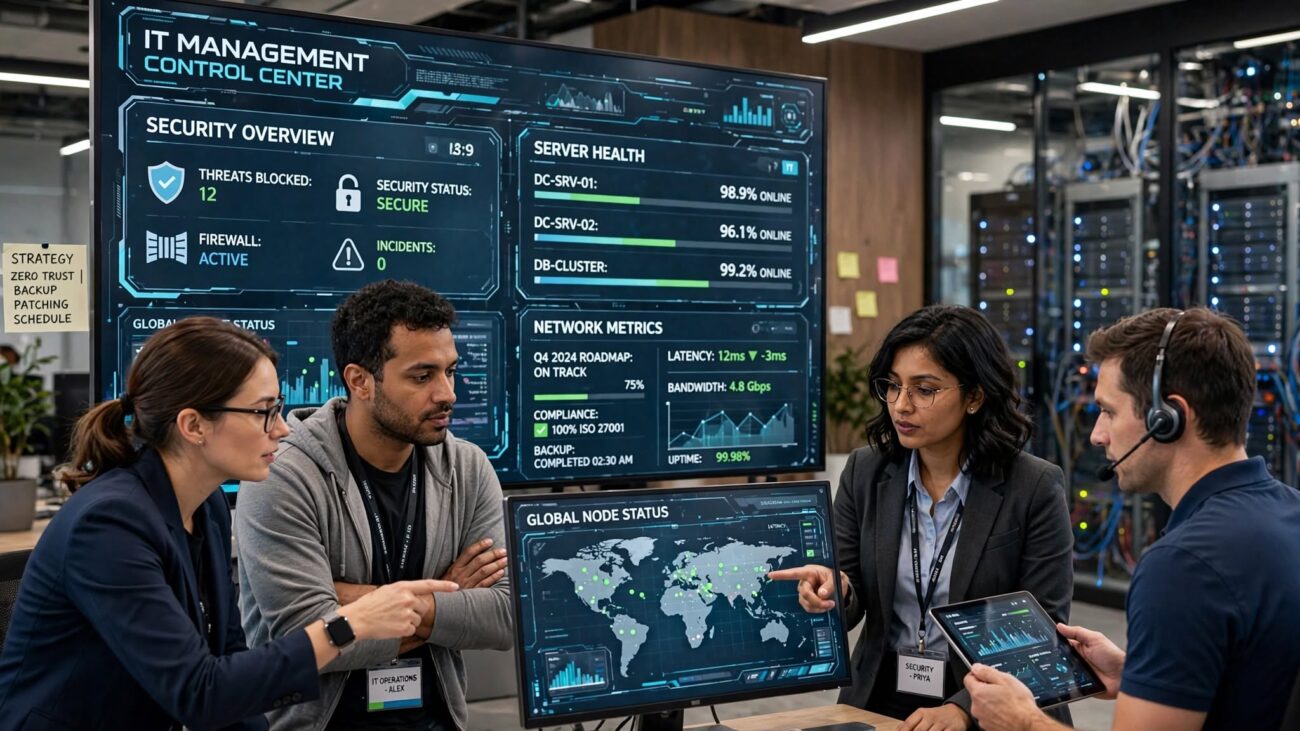
What was once a support sector has become a strategic center. And, as such, it needs structure, both physical and organizational, in order to achieve its objectives. Therefore, adopting certain guidelines for efficient IT management is essential for this area to develop and even become a competitive advantage for your company.
Furthermore, when we talk about IT management , it’s important to keep in mind that today, investing in this area is no longer a question of “if,” but rather of when and how to optimize the resources allocated to it.
According to data from FGV (Fundação Getúlio Vargas) , this idea has been consolidating. Proof of this is the growth of the G Index, which refers to total IT spending as a percentage of net revenue. In 2023, it was 9.4%. In 2024, it rose to 10% . Although the official figures for 2025 have not yet been released, growth is expected – 9.5% in the software, services, and hardware market , to give an idea.
APPLY THESE 4 GUIDELINES FOR EFFICIENT IT MANAGEMENT.
Given this scenario, it is important to have solid foundations to support the growth of this area. Adopting information security policies , investing in infrastructure and training, as well as constant monitoring and improvements, are some of the recommended actions.
See below for more details on these and other guidelines for efficient IT management.
1. ALIGNMENT WITH BUSINESS STRATEGY

Although IT is a sector with particularities that can be quite different from the core business , it is necessary to understand that it is part of a larger objective. Therefore, being in sync with other areas of the business for assertive strategic planning is of paramount importance.
Another key point is having defined performance-based metrics . This will help the IT manager set objective goals based on priorities that truly impact the business. And, of course, it will prevent the company from investing time and money in pointless projects.
2. SAFETY AS A PRIORITY
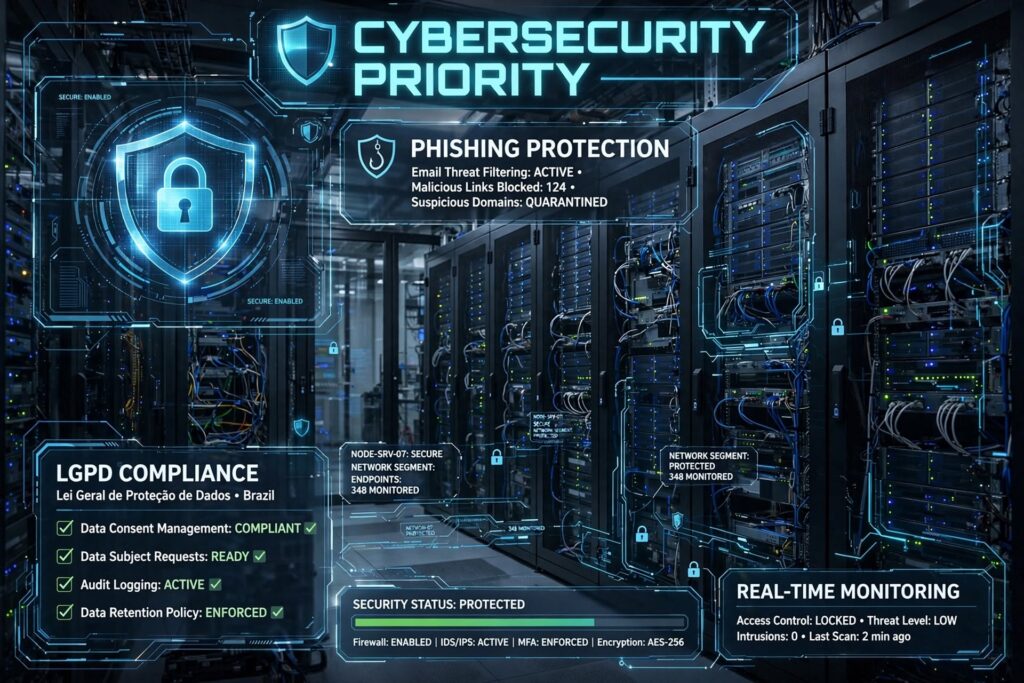
The increased investment in IT is accompanied by another trend that justifies its adoption as a business priority: the alarming number of cyberattacks .
In October 2025, Kaspersky released a worrying report. It showed that, in just 12 months, security systems blocked more than 553 million phishing attempts —attacks like the Sorvepotel virus —in the country. This kept Brazil at the top of the ranking of Latin American countries most targeted by cybercriminals, a dishonorable title we had already earned in 2024 .
Therefore, companies must consider data security as the most important guideline for efficient IT management. It needs to be established as a culture , in addition to adopting measures such as:
- Training the teams, not just the IT teams;
- Guarantee of compliance with the LGPD (Brazilian General Data Protection Law );
- Constant system updates;
- protocols and access control;
- threat monitoring;
- Cloud backup.
3. GOVERNANCE AND STANDARDIZATION
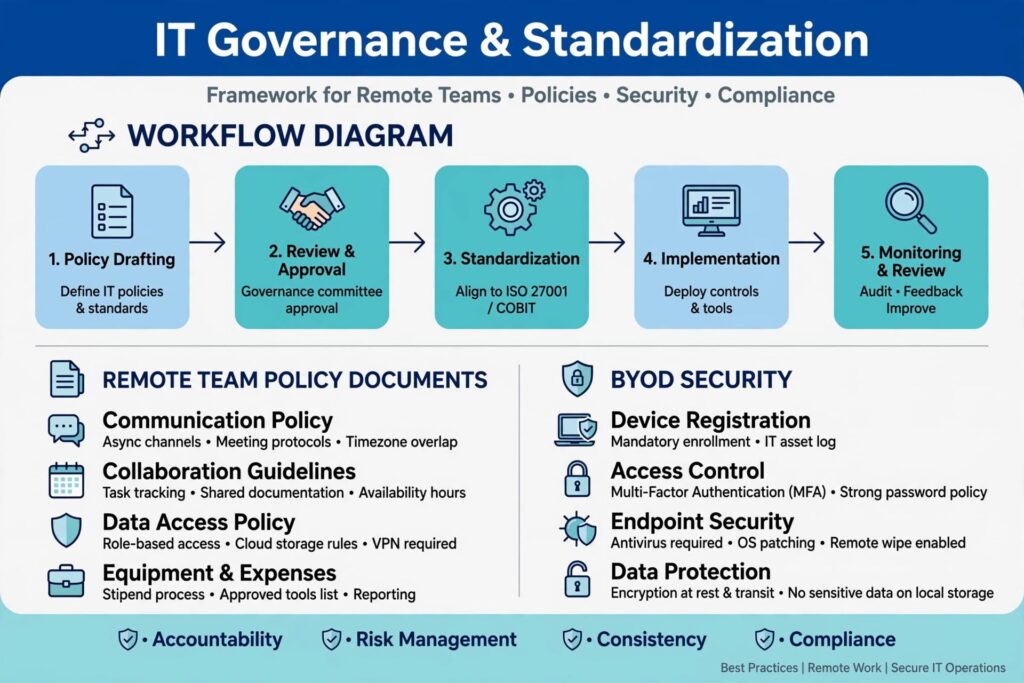
All growth requires a solid foundation. Without IT governance , it’s common to see duplicate tools, unauthorized access, communication breakdowns between teams, and wasted resources. Standardizing practices and establishing clear policies also helps increase productivity, as errors and rework become less frequent.
Consolidating governance policies and organizing the internal functioning of IT is essential for all businesses, but even more vital for those with remote teams or who adopt BYOD as an alternative . First of all, define rules for the use of systems and data. This includes defining individual access to each platform, what information teams can share, what are the best storage practices, and what procedures should be followed in case of incidents.
4. ASSET CONTROL
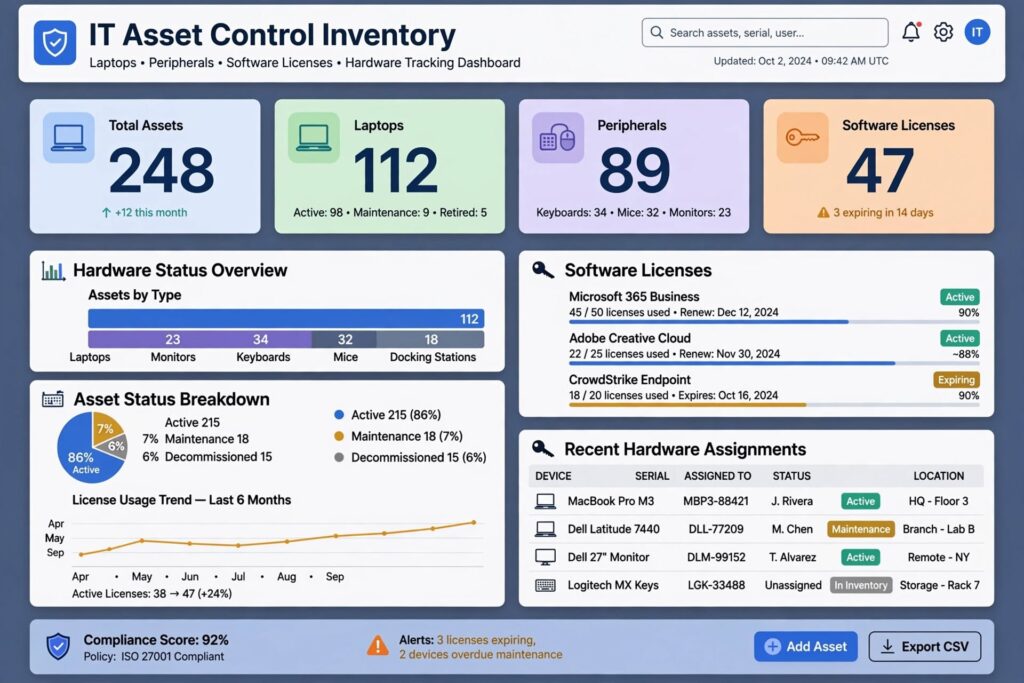
As the company grows and the IT sector consolidates, new hardware and software become necessary. Among the guidelines for efficient IT management that we have presented in this article, maintaining an up-to-date IT inventory and good asset control is fundamental in order to fulfill the points mentioned above .
READ ALSO: Big Tech companies are asking for help to curb AI before it’s too late?
Ultimately, obsolete devices, repurchases, expired licenses, and pending updates directly impact a business’s finances and data security. With this in mind, to begin implementing asset control, you will need to monitor:
- peripherals (mouse, adapters, cables, printers, UPS);
- Connectivity services (mobile, internet links);
- software (licenses);
- assets (hardware).
It is possible for some to perform this control manually. However, this will require a multidisciplinary team, which, in addition to those responsible for IT, may involve sectors such as legal and financial. However, this leads to a problem: the overload and time required, which could be allocated to more strategic functions. Therefore, the ideal solution is to have a specific technology for this task.
DISCOVER : Take control of your company’s digital security.
To help you put your guidelines for efficient IT management into practice, we’ve put together some important material. Fill out the form below and receive our fully editable and free spreadsheet to gain more organization and control over your IT infrastructure resources.
FAQ (FREQUENTLY ASKED QUESTIONS)
1. Why is it necessary to adopt guidelines for efficient IT management?
Because IT is no longer just a support sector. Today, technology directly impacts productivity, data security, and the competitiveness of companies, becoming a strategic pillar for growth.
2. What characterizes efficient IT management?
It can be said that IT management is efficient when it adopts a set of practices that align technology with business objectives, ensuring security, resource control, process standardization, and strategic use of IT investments.
3. What guidelines should be considered essential for efficient management?×
Some measures should be present in all businesses. These include:
• adopting governance policies and standardizing processes;
• prioritizing data security;
• investing in asset control of IT assets;
• aligning with the business strategy.
4. Why use a specific tool for IT asset management?
Automated solutions reduce team workload, prevent inventory errors, improve security, and free up time for more strategic activities.