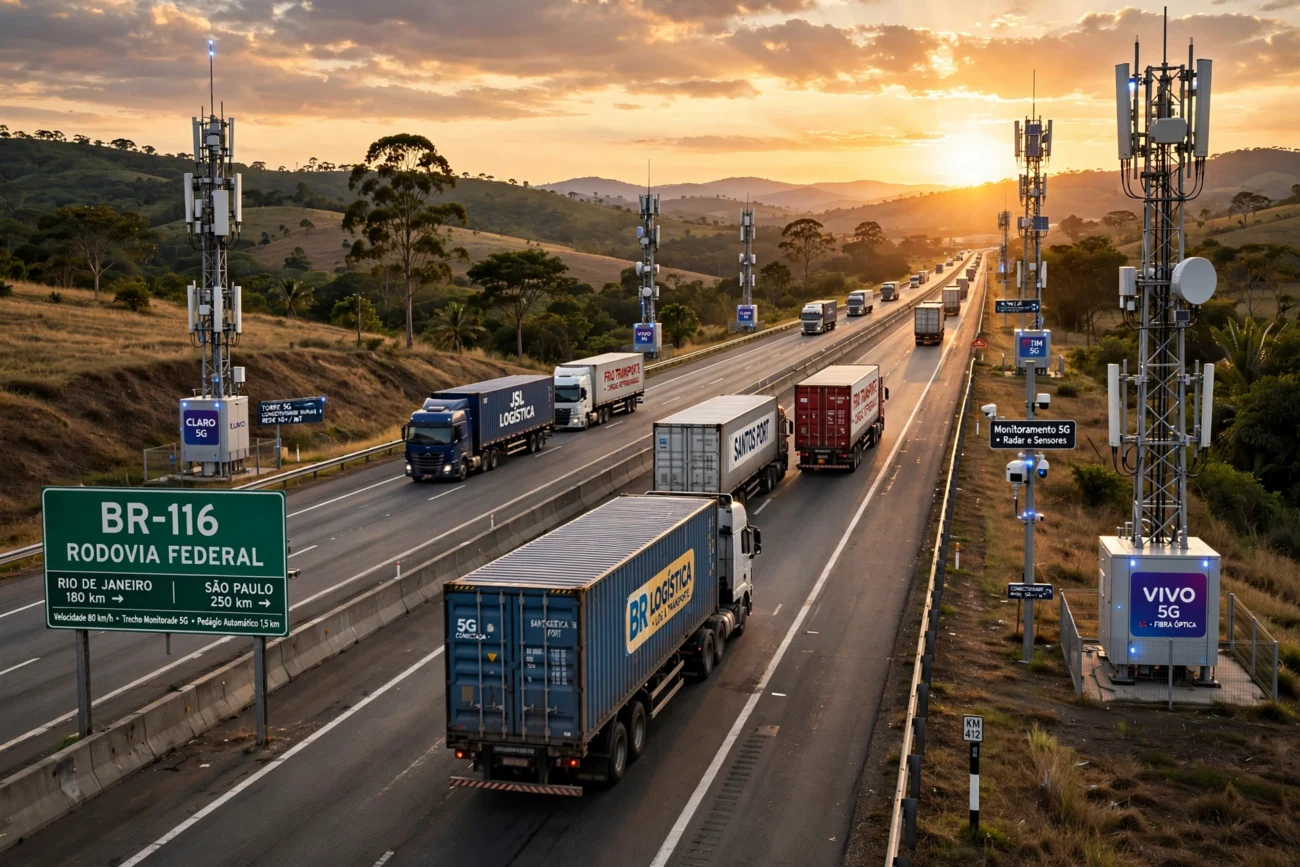
Road freight transport is, undeniably, the most important mode of transport in the country. After all, more than 60% of the goods circulating in Brazil are transported by road. To get an idea of how vital this market is to the economy, just look at the numbers for the second most used model, rail: only 19%. Given this scenario, the Federal Government has proposed a measure aimed at improving connectivity on highways .
With implementation expected as early as 2026, the National Highway Connectivity Policy aims to expand 4G and 5G service from the current 24,000 km to approximately 45,000 km per operator. Given the shutdown of 2G and 3G, which will happen by 2028, it is no wonder that the Government is treating the matter with urgency.
CONNECTIVITY ON HIGHWAYS: LEARN ABOUT THE INITIATIVE THAT AIMS TO EXPAND 4G AND 5G SIGNAL ON ROADS.
On August 7, 2025, the Federal Government opened a public consultation regarding the establishment of the National Highway Connectivity Policy, proposed by the Ministry of Communications (MCom). This was not the Ministry’s first action to promote connectivity on highways.
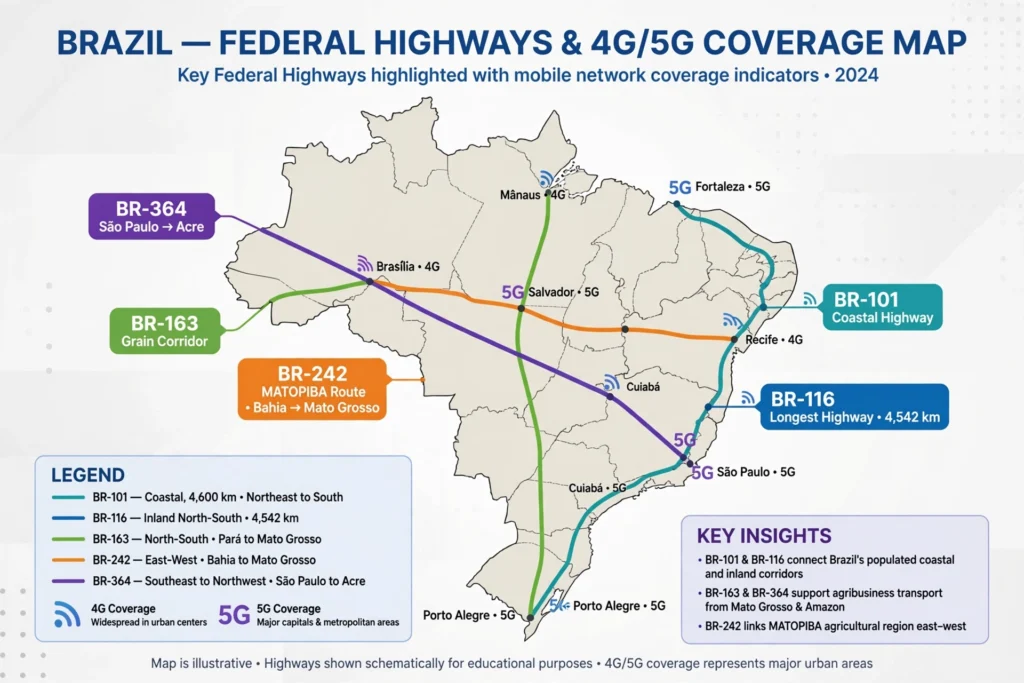
In July of that same year, the Ministry of Communications (MCom) published Ordinance No. 18,902/2025 . This ordinance established guidelines for the auction of the 700MHz band, which includes full coverage of highways BR 101, BR 116, BR 163, BR 242, and BR 364.
The public consultation on the National Highway Connectivity Policy received 76 contributions and ended on October 22nd. Initially, the Government expected to publish the document by December 5th, 2025. However, the deadline has been extended, and now it is expected to be published in March 2026.
UNDERSTAND HOW THE GOVERNMENT WANTS TO ENABLE GREATER CONNECTIVITY ON HIGHWAYS.

The new policy for road connectivity aims to expand 4G and superior technologies in two ways. The first is to bring signal to areas still without coverage. The second is to ensure that users have continuous access to the service , even outside the coverage area of their contracted operator. Regarding the latter, there is a challenge that the Government intends to overcome by 2026: the unequal coverage among operators. Today, TIM covers 39.6% of highways, Claro 39.25%, and Vivo 34.8%. To address this, the goal is to have operators share infrastructure among themselves in what is called ” roaming . “
READ ALSO: Big Tech companies are asking for help to curb AI before it’s too late?
According to the Minister of Communications, Frederico Siqueira, in cases where there is no concession, the telecommunications sector will be responsible for bringing connectivity infrastructure to the highways.
OVERVIEW OF HIGHWAY CONNECTIVITY: WHAT IS THE CURRENT STATE OF 4G AND 5G COVERAGE?
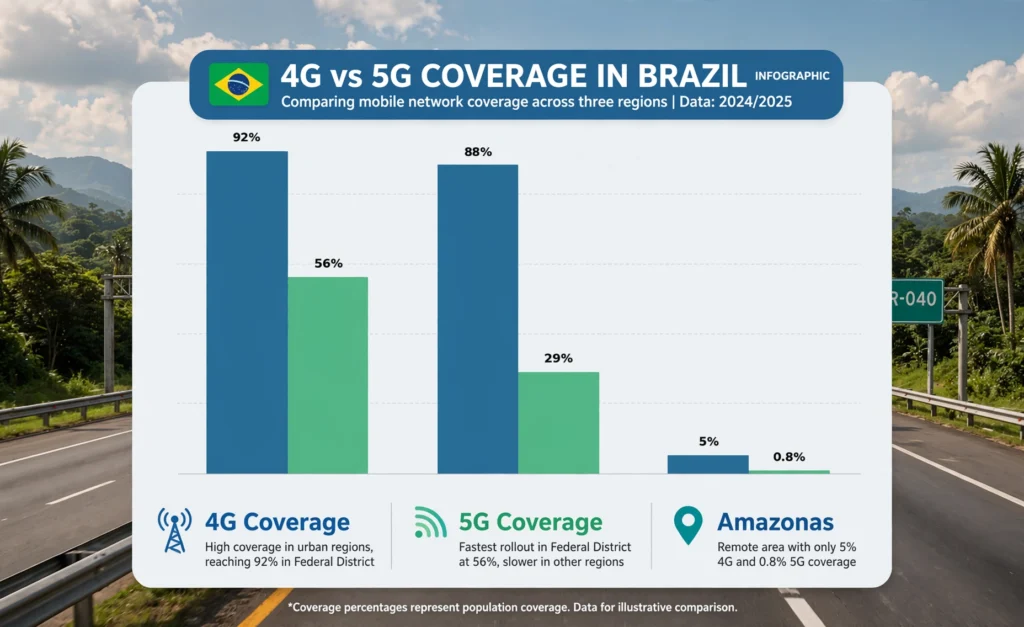
It is undeniable that 5G still needs to evolve significantly in terms of highway connectivity. Currently, only 10.7% of the 112,354 km of federal highways have 5G coverage. However, the scenario changes when we refer to the previous technology, 4G . This already covers more than 53.2% of the highway network.
Although it may seem that 4G and 5G coverage is advancing, the disparity between states cannot be ignored . The Federal District, for example, leads in 4G coverage, with over 92% of its network covered by the signal. São Paulo, the second-leading state, has over 88%. Meanwhile, in Amazonas, only 5% of federal highways have access to this technology.
Regarding 5G, the discrepancy becomes even more evident. Considering the states mentioned earlier, the Federal District (DF) has 56.3% of its highways covered by 5G. São Paulo, 29.5%. Amazonas, the state with the most deficient highway connectivity, has only 0.8%.
SHUTDOWN OF 2G AND 3G: ANOTHER IMPORTANT TOPIC IN HIGHWAY CONNECTIVITY.

Since April 2025, Anatel has stopped certifying devices that operate exclusively on these generations of mobile internet networks. The measure, imposed by Act No. 14430 , seeks to ensure a structured transition, given that 2G and 3G networks will be switched off by 2028.
This, which is a global trend, aims to free up sub-1 GHz bands for 5G allocation . Although there is still operating time, operators have already stopped prioritizing 2G and 3G networks and have allocated resources to expanding 4G and 5G.
The migration directly affects the transportation and logistics sectors, which depend almost exclusively on older technologies. Conversely, with the switch-off, the trend is for 4G and 5G coverage to expand significantly.
To understand this transition and know how to act, check out the article ” 2G and 3G Shutdown: Is your company prepared? “. In it, you’ll find the regulatory issues surrounding this topic and an essential checklist for making the changes smoothly and without major financial or operational impacts.
FAQ (FREQUENTLY ASKED QUESTIONS)
1. What is the National Highway Connectivity Policy?
It is a Federal Government initiative that aims to expand 4G and 5G coverage on Brazilian federal highways, bringing signal to stretches without coverage and ensuring continuous connectivity for users.
2. Why is highway connectivity important for the transportation sector?
Because road transport moves more than 60% of the country’s cargo and depends on a stable connection for tracking, telemetry, communication, and operational safety.
3. What is the current 4G and 5G coverage on federal highways?
Today, 4G covers more than 51% of the federal highway network, with significant differences between states. Meanwhile, 5G is still quite limited: only 9.2%.
4. What is the impact of the 2G and 3G shutdown on highway connectivity?
The switch-off, scheduled for 2028, should free up frequencies for 4G and 5G, increasing coverage and connection quality. However, it requires the updating of older devices.